How Peer-to-Peer Cookbook Fundraising Actually Increases Profit
Participant pages + sharing to friends/family + why it works. Most fundraisers have a built-in ceiling. Not because your cause isn’t worthy, but because the “sales force” is basically one exhausted organizer and a handful of helpers posting the same link three times while whispering, “Please don’t let this flop.”
Peer-to-peer fundraising raises that ceiling by changing who does the asking.
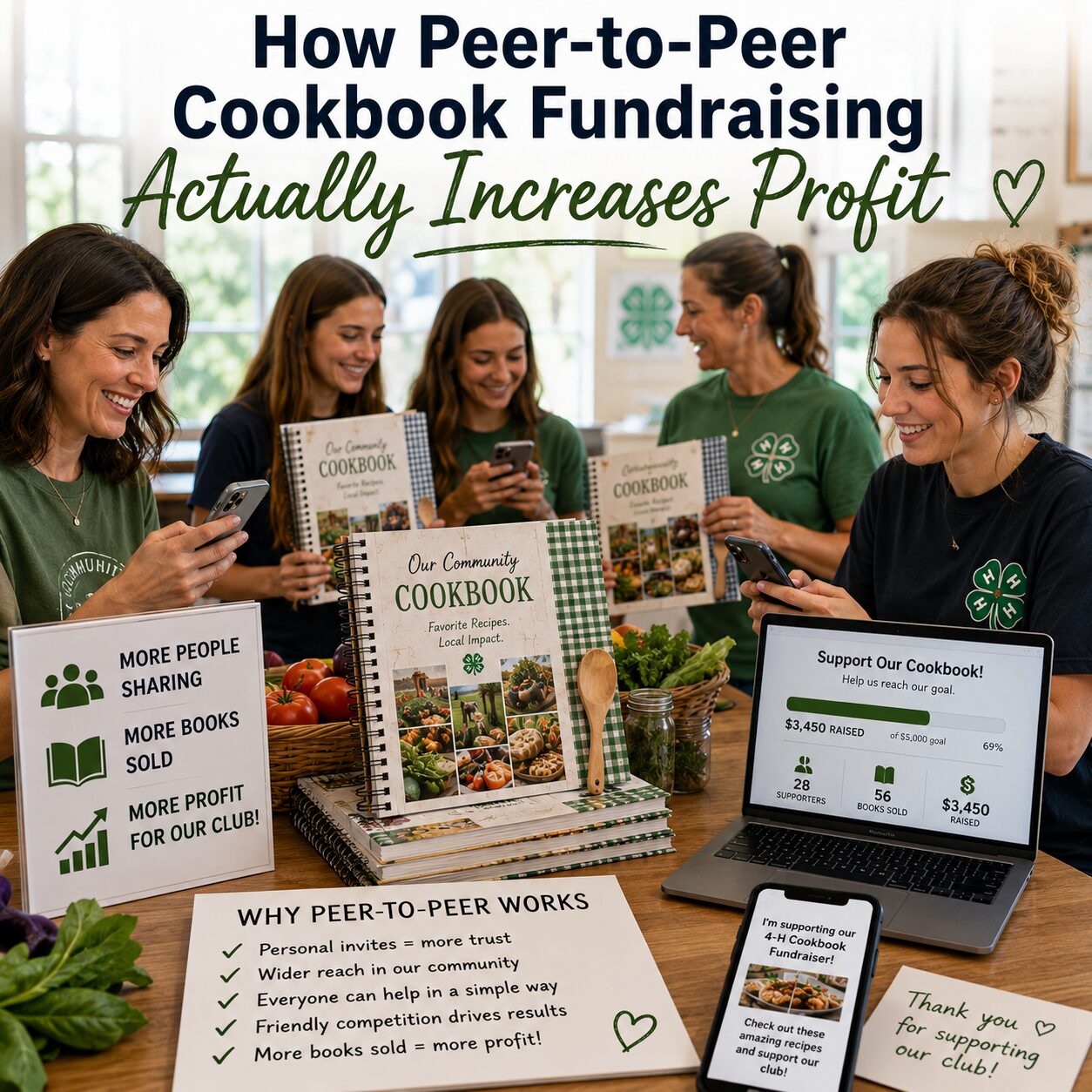
Instead of your organization shouting into the internet void, you get dozens (sometimes hundreds) of people sharing the fundraiser with their own friends and family—through participant pages that feel personal, credible, and specific. CookbookFundraiser.com is designed for exactly this: it supports a peer-to-peer approach where participants reach out to friends and family, and Sales Hub can give members a personal website to share.
This is why peer-to-peer campaigns routinely outperform “central link only” campaigns: more reach, more trust, more conversions, and more total orders.
The key profit idea: you’re multiplying warm networks
Traditional selling is cold outreach. Peer-to-peer is warm outreach.
A donor who ignores an organization post might immediately respond to a friend’s message that says, “Hey—this helps our band travel this season. Would you grab a cookbook?”
That isn’t magic. It’s social psychology: people pay attention to people they know.
Peer-to-peer fundraising is commonly described as giving supporters their own personal fundraising pages to share with friends, family, and colleagues, which expands reach beyond the organization’s usual audience. Donately+1
What “participant pages” do that a single fundraiser page can’t
CookbookFundraiser.com emphasizes that the platform supports peer-to-peer outreach, and its FAQ describes Sales Hub participants receiving a personal website they can send to friends and family. Cookbook Fundraiser+1
That matters because a participant page is not just “a link.” It’s a conversion tool with three built-in advantages:
- It makes the ask feel personal
Instead of “Please support this organization,” it becomes “Please support me supporting this organization.” Personal motivation beats generic promotion almost every time. - It creates a trust shortcut
Your participant is essentially vouching for your fundraiser. That borrowed trust reduces hesitation and increases the odds someone buys or donates. - It gives the participant ownership
When someone has “their page,” they’re more likely to share it more than once, follow up, and keep going—because it feels like their mini-campaign, not a favor they did once.
Cookbooks.tips even describes participant pages that can include a photo/video/intro, which makes the page more persuasive to that person’s network.
The profit math: small effort × many participants = big revenue
Peer-to-peer is basically multiplication disguised as community spirit.
Let’s do clean, realistic math:
- You recruit 25 participants (families, students, members, alumni).
- Each participant shares their page with 30 people (a mix of text, email, and social).
- Only 10% buy (3 buyers each). That’s not a heroic conversion rate—it’s normal for a warm network.
- Average order is 1 cookbook.
That’s 25 × 3 = 75 cookbook orders.
Now compare it to a non-peer-to-peer campaign:
- One organizer posts the link.
- A few people share it once.
- The link reaches fewer unique people, and it doesn’t carry the same personal trust.
Peer-to-peer doesn’t just increase orders—it increases the number of independent “micro-campaigns” running at the same time.
Why peer-to-peer raises conversion rates (not just reach)
Reach alone is nice, but profit comes from conversions.
Peer-to-peer improves conversion because:
People respond to a direct ask more than a broadcast
A DM or a personal email outperforms “here’s a link” posts. It feels like an invitation, not an ad.
Buyers feel connected to a specific person
That connection can tip someone from “maybe later” to “sure, I’ll do it now.”
It creates repeat touches without being annoying
One participant might post twice. Another texts. Another emails. You get multiple reminders across different circles—without your organization spamming the same audience.
The cookbook-specific advantage: contributors become buyers (and sellers)
CookbookFundraiser.com calls out a huge dynamic that other fundraisers don’t get for free: recipe contributors are also likely cookbook buyers, so more participation tends to mean more sales.
Cookbooks are personal. If someone’s recipe is in it (or their kid’s team is in it), the cookbook becomes a keepsake, not a product. That increases buying and gifting.
And gifting is where profit quietly doubles:
- one buyer grabs an extra copy for grandparents
- another buys for a coach/teacher
- someone buys a copy “to support” even if they barely cook (classic fundraiser behavior)
What Sales Hub adds: structure + reminders + momentum
Peer-to-peer only works if participants actually participate.
CookbookFundraiser.com’s FAQ describes being able to upload a list of members, send reminders, and give participants personal websites to share.
That combination is the difference between:
- “We hope people share,” and
- “We have a system that nudges sharing into existence.”
This is where profit increases in real life: not because your members are suddenly born marketers, but because you remove friction and prompt action at the right times.
The “why it works” in one sentence
Peer-to-peer works because it turns one fundraiser into many small fundraisers run by people with real relationships.
Peer-to-peer fundraising guides from major fundraising platforms describe the same core mechanism: supporters create personal pages and share them with their networks, expanding reach and increasing results without adding staff workload.
How to run peer-to-peer so it actually boosts profit (and doesn’t fizzle)
You don’t need a complex strategy. You need a simple cadence.
Recruit participants intentionally
Don’t just say “everyone share.” Assign roles:
- 10 “super-sharers” (committee, leaders, outgoing parents)
- 20+ regular participants (one share per week is fine)
Give everyone a tiny, clear job
The best assignment is brutally specific:
- Share your page 3 times during the campaign
- Text 10 people you actually know
- Post once during the final week
Make progress visible
Leaderboards, shout-outs, “we hit 50 books!” updates—momentum sells.
Use “reasons” people can borrow
Participants share more when you give them language:
- what the funds do
- why this is better than candy/coupon books
- why the cookbook is meaningful
Run a strong final-week push
Most campaigns make a lot of sales at the end because deadlines create decisions. Remind people the presale window is closing and this is the last easy chance to support.
One more sneaky profit lever: donations + shipping convenience
CookbookFundraiser.com notes donations can be part of the fundraiser and can be very profitable.
And when supporters can order online (and even have books delivered to their door), fewer people drop out due to hassle.
Convenience increases conversion. Conversion increases profit. Fundraising is weirdly mathematical that way.
The takeaway
Peer-to-peer cookbook fundraising increases profit because it scales the thing that actually drives fundraising: trusted, personal asks.
Sales Hub participant pages (personal websites), easy sharing, and automated reminders turn your group into an organized “army of micro-fundraisers”—and cookbooks have the built-in advantage that participation creates ownership, which creates sales.
It’s not louder fundraising. It’s smarter fundraising. And it doesn’t require anyone to stand outside a grocery store wearing a mascot head at 7am, which is a philanthropic victory all by itself.
Bill Rice is the Co-Publisher of Family Cookbook Project and CookbookFundraiser.com which helps individuals, churches, schools, teams and other fundraising groups create cherished personalized cookbooks using AI tools, peer-to-peer tools and the power of the Internet to meet group funding needs Follow Family Cookbook Project on Facebook, Instagram, Twitter (X), TikTok, YouTube and Pinterest!