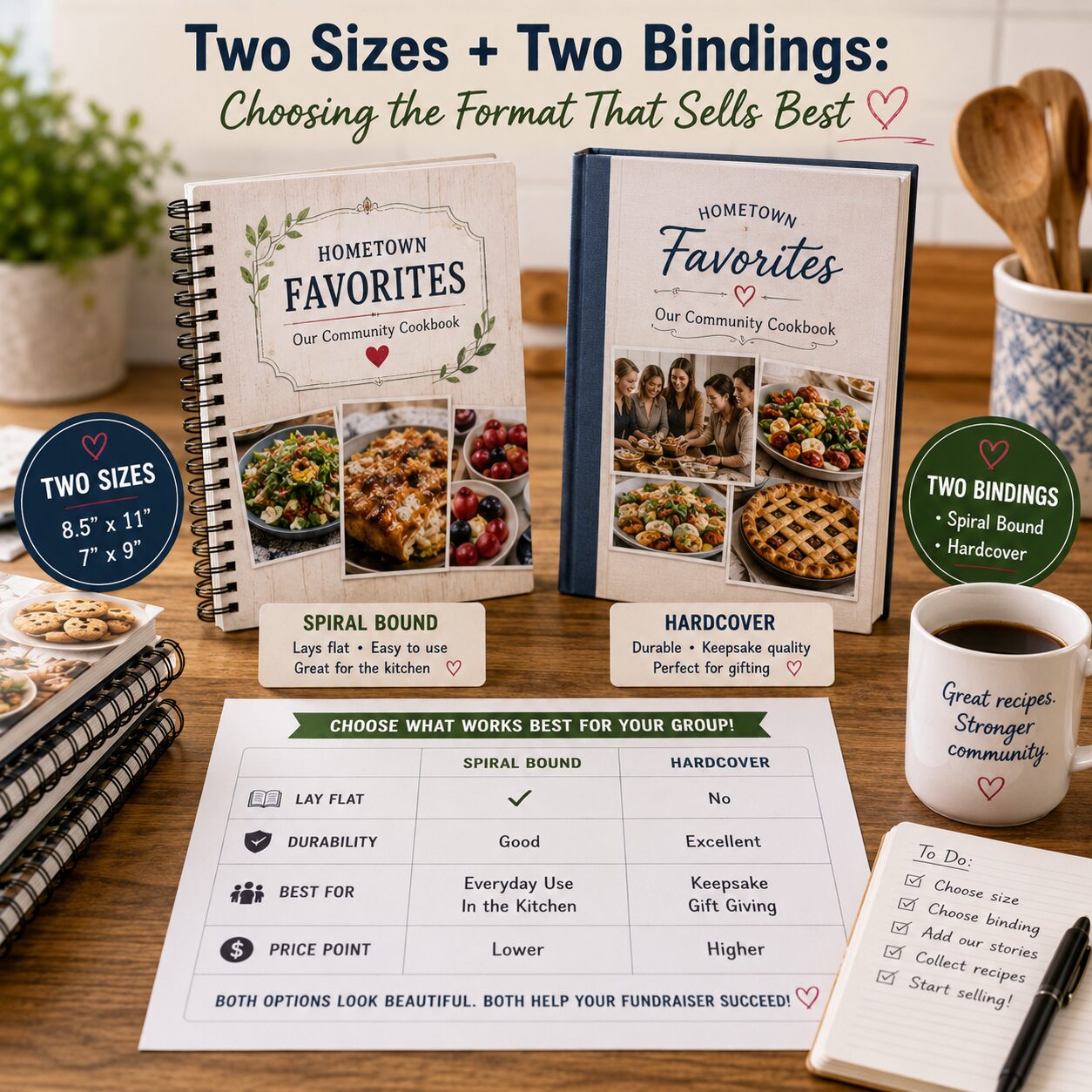
Two Sizes + Two Bindings: Choosing the Format That Sells Best
Standard vs large; coil vs hardcover—what fits which audience. Cookbook format sounds like a boring detail until you realize it changes three things that matter a lot:
- how “giftable” the cookbook feels
- how easy it is to use in the kitchen
- how confidently people will pay your fundraiser price
So yes—size and binding can influence sales. Not because buyers are picky, but because buyers are human. They buy what feels useful, durable, and worth it.
Here’s how to choose two sizes (standard vs large) and two bindings (coil vs hardcover) based on your audience.
First: what buyers are really deciding
When someone sees your fundraiser cookbook, they subconsciously ask:
- “Will I actually use this?”
- “Will it survive my kitchen?”
- “Is this a nice gift or just a fundraiser item?”
- “Is the price fair for what I’m getting?”
Size and binding answer those questions faster than your sales pitch.
Size: Standard vs Large
Standard size sells best when your audience wants convenience and portability
Best for:
- busy parents
- youth sports teams
- PTA/PTO communities
- booster clubs
- scouting / 4-H
- workplaces and clubs
- anyone buying primarily “to support” plus occasional use
Why it sells:
- easy to store on a shelf
- lighter and simpler to carry
- feels like a “normal” cookbook purchase
- typically keeps costs lower, which helps your margin or keeps the price approachable
The vibe: practical, everyday, “I’ll actually open this.”
Large size sells best when your audience values readability and “kitchen-friendly”
Best for:
- older supporters (grandparents, retirees)
- churches and community groups
- foodies/home cooks who will actually cook from it
- groups with lots of recipe content and photos
- gift-heavy audiences (holidays, community legacy projects)
Why it sells:
- larger text and layout feel easier to read
- bigger pages feel more premium
- more room for photos and stories
- looks impressive as a gift
The vibe: “this is a real book,” not just a fundraiser.
Easy rule:
If your supporters skew toward “I’ll cook from it,” large format helps.
If your supporters skew toward “I’m buying to support,” standard is usually the cleanest fit.
Binding: Coil vs Hardcover
Coil binding sells best when kitchen usability is the top priority
Best for:
- heavy kitchen users
- busy families
- anyone who cooks while distracted (which is… all humans)
- organizations where the cookbook will be used at events, potlucks, and shared
Why it sells:
- lays flat on the counter (the #1 usability feature)
- pages are easy to flip with one hand
- feels durable and practical
- buyers instantly “get it” when they handle it
The vibe: “made to be used.”
Hardcover sells best when gifting and “keepsake value” matter most
Best for:
- holiday-season campaigns
- legacy/community books (churches, alumni groups, civic orgs)
- donors who like premium items
- “one for me, one for Grandma” audiences
- higher-price tolerance buyers
Why it sells:
- looks premium on a coffee table or shelf
- feels like a meaningful gift
- increases perceived value (which supports a higher fundraiser price)
- people associate hardcover with permanence
The vibe: “this matters.”
Important reality:
Hardcover can sell very well—but only if your audience is comfortable with a higher price. Hardcover is easier when your group has strong donor culture or gift culture.
The best-selling combos (by audience type)
If your audience is parents + busy families (schools, teams, youth groups)
Top seller: Standard + Coil
It’s practical, affordable-feeling, easy to use, easy to buy.
If your audience is community + potluck culture (churches, civic groups, food pantry supporters)
Top seller: Large + Coil
Readable, user-friendly, great for frequent cooking, still feels substantial.
If your audience is gift-driven (holidays, alumni, “heritage” projects)
Top seller: Standard or Large + Hardcover
Pick size based on age/readability, but hardcover drives the “gift” feeling.
If you want one “universal best bet”
Most universally safe: Standard + Coil
It rarely offends, rarely creates sticker shock, and is highly usable.
Should you offer multiple options or keep it simple?
Keep it simple (one format) if:
- you want the easiest campaign
- you expect most buyers are casual cooks
- you don’t want to manage preference questions
- your fundraiser success depends on speed and low friction
Offer two options if:
- you have a gift-heavy base and a practical-cook base
- you can clearly explain the difference in one sentence
- you’re using online ordering where choosing a format is easy
A clean two-option menu looks like this:
- Standard Coil (Everyday Kitchen Edition)
- Hardcover (Gift & Keepsake Edition)
People love being guided. Don’t make them guess.
How to message the formats so they sell
Use benefit language, not specs.
Coil message:
“Lays flat while you cook—made for real kitchens.”
Hardcover message:
“Beautiful keepsake—perfect for gifting.”
Standard size message:
“Easy to store, easy to use.”
Large size message:
“Bigger, easier to read—great for home cooks.”
That’s enough. Buyers don’t need a dissertation. They need a nudge.
The takeaway
Format sells when it matches the way your supporters will use the book:
- Standard + Coil = practical, easiest-to-sell, widest appeal
- Large + Coil = best for readability and frequent cooking
- Hardcover = best for gifting, donors, and “keepsake” positioning
Choose the format that fits your audience’s habits and price comfort, and you’ll make ordering feel like a “yes” instead of a decision.
Bill Rice is the Co-Publisher of Family Cookbook Project and CookbookFundraiser.com which helps individuals, churches, schools, teams and other fundraising groups create cherished personalized cookbooks using AI tools, peer-to-peer tools and the power of the Internet to meet group funding needs Follow Family Cookbook Project on Facebook, Instagram, Twitter (X), TikTok, YouTube and Pinterest!