Church Youth Groups: A “Potluck Classics” Cookbook Fundraiser for Mission Trips
Church youth groups have a particular superpower: they can organize a service project, run a fundraiser, and create lifelong memories… all while surviving a van ride that sounds like a podcast recorded inside a drum.
They also have a familiar challenge: mission trips cost money. Transportation, lodging, registration fees, supplies, fundraising goals, and the “we forgot we need matching shirts” moment all add up fast. And while the classic fundraising options can work, they often come with tradeoffs—time-heavy events, awkward selling, or supporter fatigue from being asked to buy one more thing.
A “Potluck Classics” cookbook fundraiser is a church-y, community-building alternative that fits the culture. It doesn’t feel like a sales pitch. It feels like a keepsake. It captures the congregation’s personality, involves people who can’t travel, and gives supporters a tangible way to be part of the mission trip.
Here’s the sneaky-effective structure to make it work.
The church youth group fundraiser pain you already know
Youth group fundraising has three predictable friction points.
First: time and coordination. Spaghetti dinners, bake sales, car washes, and events require planning, volunteers, and a specific day when everything goes right. That’s hard when families already juggle busy calendars.
Second: supporter fatigue. The congregation is generous, but repeated “buy this” requests can start to feel like an endless parade of fundraisers—especially if multiple ministries are fundraising at the same time.
Third: limited participation. Some members can’t attend events, can’t volunteer, or live far away—but still want to support the youth. In-person fundraisers can unintentionally exclude these supporters.
A cookbook fundraiser solves these problems by being inclusive and asynchronous: people can contribute a recipe from anywhere, share a link from anywhere, and buy/support from anywhere. The mission trip becomes the story, and the cookbook becomes the vehicle.
Why a “Potluck Classics” cookbook fits church youth groups so well
Church communities already have two essential ingredients for a cookbook fundraiser:
Shared food traditions
Potlucks are basically a sacrament in many congregations. Every church has “that casserole,” “that dessert,” and “that dish that disappears before the prayer finishes.”
A multigenerational community
A cookbook fundraiser invites participation from people who might not be able to travel on the mission trip—grandparents, older members, families who are busy, and friends of the church. It’s a fundraiser that says, “You can be part of this.”
It also fits the spirit of mission trips: collective effort. Everyone contributes something. Not everyone goes, but everyone can support the going.
And unlike generic fundraiser products, the cookbook feels like it belongs to the community. People buy it because it includes familiar names and recipes they’ve eaten at church for years.
The signature angle: “Potluck Classics” + “Mission Trip Stories”
The theme is the hook: Potluck Classics.
But the secret sauce is pairing recipes with purpose. You’re not just selling a book. You’re inviting people into the mission.
A strong structure looks like this:
Potluck Staples
Casseroles, pasta bakes, slow cooker classics, big-batch recipes.
Sides That Always Vanish First
Salads, breads, veggie dishes, “church basement crowd-pleasers.”
Dessert Table Legends
Bars, cookies, sheet cakes, pies—the stuff people ask for by name.
Quick Weeknight Meals (Youth Group Families Edition)
Because youth group parents are living on schedules and grace.
Mission Trip Team Favorites
Recipes from the students going on the trip—simple, personal, and fun.
Now add the differentiator: include short “Mission Notes” throughout the book:
- why the trip matters
- what the group is raising money for
- a few student reflections (short and sincere)
- a “prayer and encouragement” page (optional, appropriate to your community)
Even 1–2 sentences per student makes the book feel alive. It turns “a cookbook” into “our youth group’s mission story.”
Optional: add a “Church Recipe Heritage” section
Invite older members to contribute long-loved recipes. This increases participation and boosts sales because families want the “classic” recipes preserved.
How to run it without burning out volunteers (and without turning it into a committee marathon)
The best church fundraisers are the ones that don’t quietly consume the ministry team.
Here’s a simple plan.
Choose one editor and a small support team
One person needs to drive the project forward—often a youth leader, parent volunteer, or organized committee member. A small support team can help gather recipes, recruit sponsors, and handle promotion. Keep it focused.
Set a clean 6-week timeline
Week 1: Announce fundraiser + theme + mission trip goal
Weeks 2–4: Collect recipes + open online sales
Week 5: Final edits + “last call” push
Week 6: Publish/print + delivery plan
Align the final push with a church moment:
- a Sunday announcement
- a youth-led service
- a commissioning service for the trip
- a potluck Sunday (perfect timing)
Make the recipe request easy and inviting
Ask each family or church member for:
- 1 recipe (2 max if they’re enthusiastic)
- basic ingredients + directions
- optional: a short note (“why this dish matters”)
This keeps the barrier low, so more people participate.
Make selling feel like sharing, not “selling”
Give youth a simple, comfortable script:
“Here’s our cookbook fundraiser to help fund our mission trip. If you’d like to support, you can buy a cookbook (or donate) and help us reach our goal.”
That’s it. No pressure. No awkward pitch. The story does the work.
Use youth-friendly goals that feel achievable
Instead of “raise $X,” assign simple actions:
- each student asks 10 people to share the fundraiser link
- each student aims to sell 5 cookbooks
- each student submits 1 recipe + 1 short mission note
Small actions scale up quickly.
Profit boosters that work especially well for mission trip fundraising
If you need to cover a portion of costs, cookbook sales may be enough. If you’re funding a full trip, add boosters that increase results without increasing complexity.
Sponsor pages from local businesses and church members
Local businesses love being associated with service. So do church members who want to “sponsor” in a meaningful way. Offer tiers:
- full page sponsor
- half page sponsor
- “supporter listing”
- dedication page sponsorship (someone funds a page in honor of a loved one)
The dedication sponsorship is especially powerful in church communities: it’s relational and meaningful.
Donations for supporters who don’t need a cookbook
Many supporters want to contribute but don’t need another book. A donation option makes it easy for them to help without purchasing. It also reduces friction for out-of-town supporters.
Bundle the cookbook with a church event
A potluck Sunday + cookbook campaign is a natural pairing:
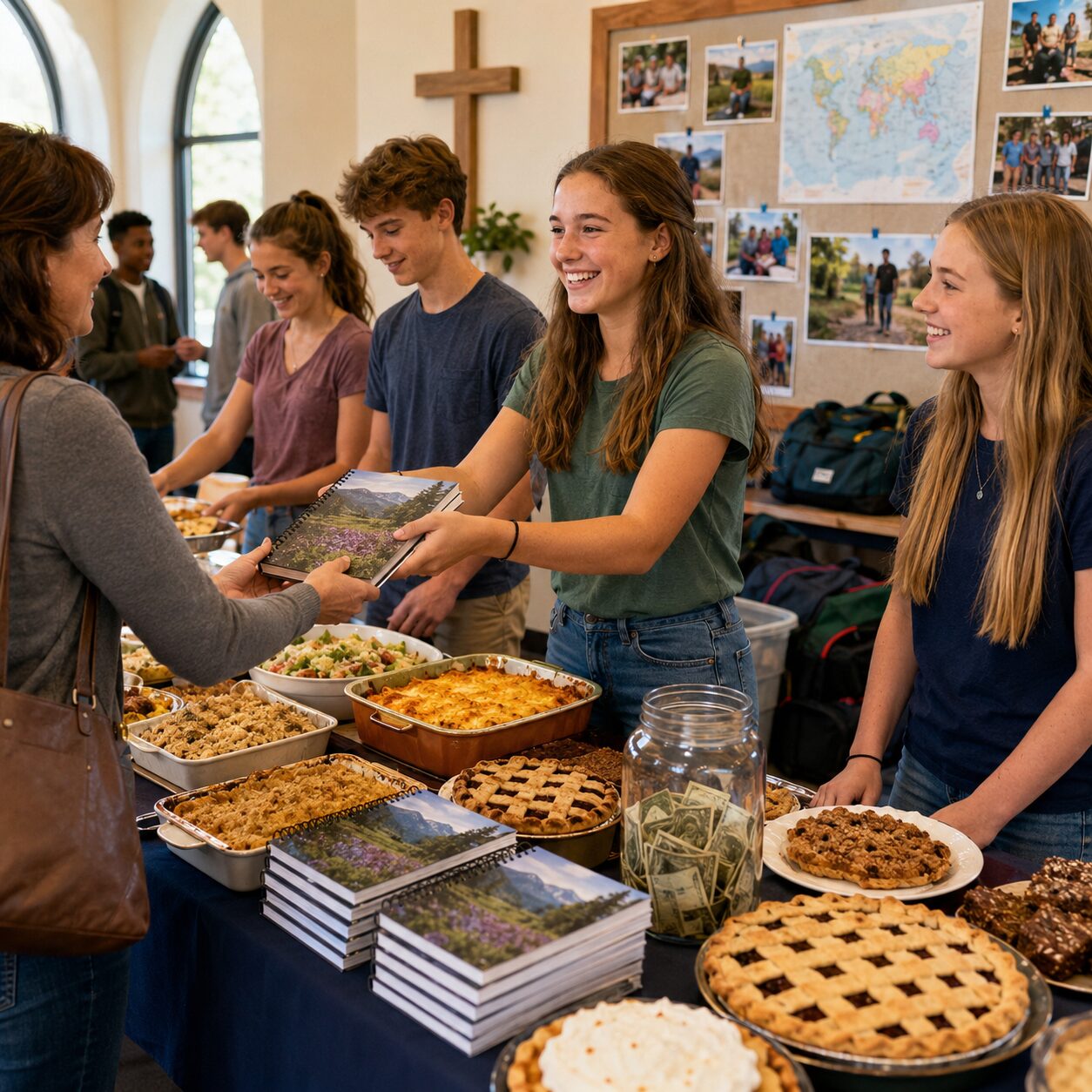
- sample recipes from the book at the potluck
- have a display table with a preview copy
- let people order on the spot (or by QR code)
When people taste and connect, they buy.
Messaging that gets the congregation to participate (copy-ready)
Here’s a message that feels authentic and mission-driven:
“Our youth group is raising money for our upcoming mission trip. Instead of a time-heavy fundraiser, we’re creating a ‘Potluck Classics’ church cookbook filled with favorite recipes from our congregation and our students. Please submit one recipe by Friday and support the trip by purchasing a cookbook (or making a donation). This cookbook is a keepsake that helps send our youth to serve.”
Short, warm, and purpose-forward.
For students, keep it simple:
“Buy a cookbook, help us serve.”
The finish: make the cookbook part of the mission trip story
When the fundraiser ends, don’t just hand out books—close the loop.
At distribution time:
- announce the total raised and what it covers (travel, lodging, supplies)
- thank sponsors and contributors publicly
- include a “mission trip update” plan (photos, stories, testimony night)
- invite buyers to pray for the group
After the trip, do one more community moment:
- share highlights in a service or newsletter
- thank supporters again
- show how their cookbook purchase helped create real impact
That’s the magic. The cookbook isn’t just fundraising. It’s connection—between those who go and those who send.
And because it’s built around potluck classics, it also preserves a piece of your congregation’s shared life—the kind of ordinary goodness that quietly holds communities together.
Bill Rice is the Co-Publisher of Family Cookbook Project and CookbookFundraiser.com which helps individuals, churches, schools, teams and other fundraising groups create cherished personalized cookbooks using AI tools, peer-to-peer tools and the power of the Internet to meet group funding needs Follow Family Cookbook Project on Facebook, Instagram, Twitter (X), TikTok, YouTube and Pinterest!