
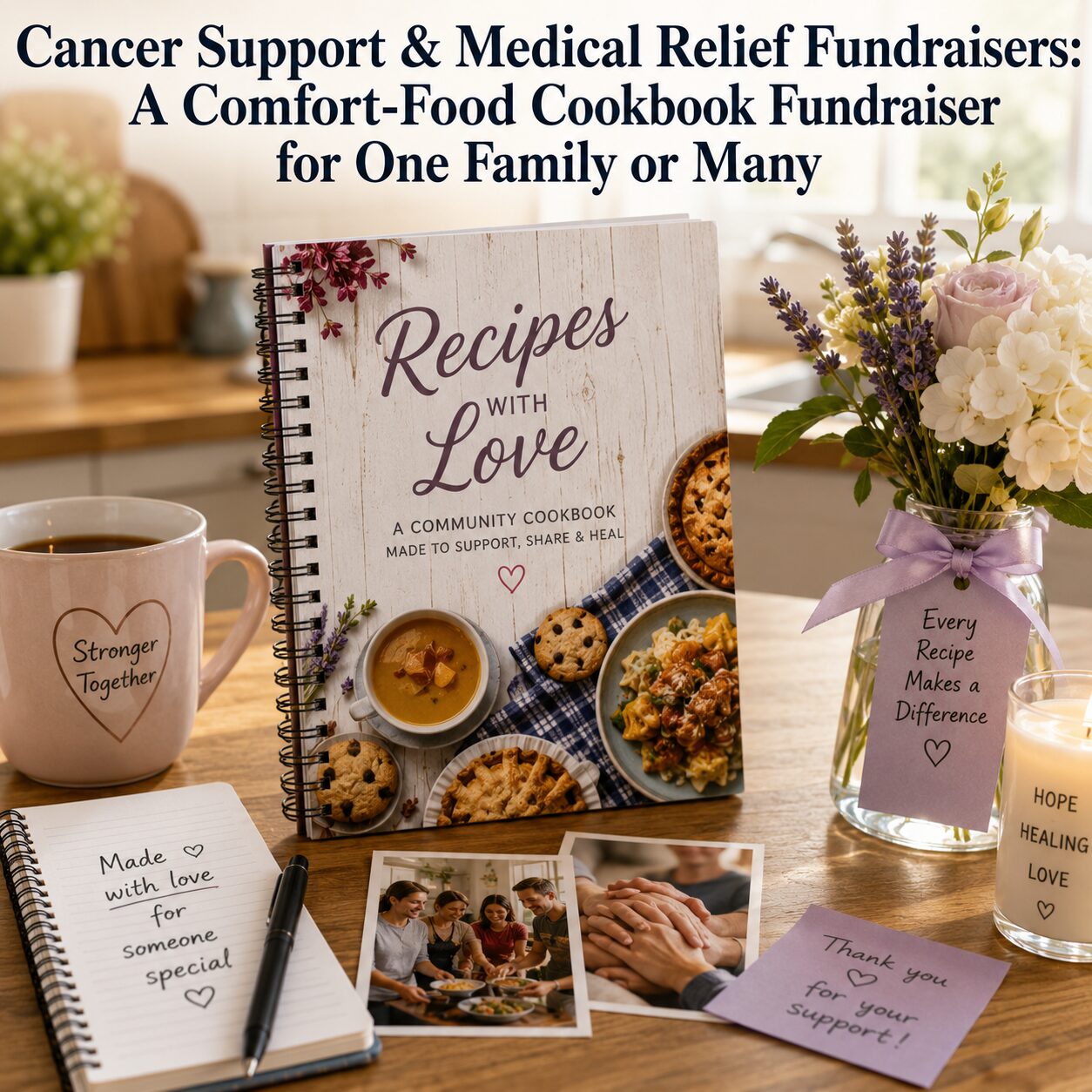
Cancer Support & Medical Relief Fundraisers: A Comfort-Food Cookbook Fundraiser for One Family or Many
When someone is facing cancer—or any serious medical crisis—the “hard part” isn’t one thing. It’s everything, all at once.
It’s appointments and paperwork. It’s missed work and travel. It’s insurance calls that feel like they were designed by a bored villain. It’s meals that suddenly matter more because energy is low, taste changes, or the whole family is living in survival mode. And it’s expenses that pile up in ways most people don’t see until they’re in it.
Communities usually respond the best way they know how: they show up. They organize fundraisers, meal trains, benefits, auctions, and donation drives.
The challenge is that medical relief fundraising can become exhausting for organizers and emotionally heavy for the family. You need something that raises meaningful funds, includes lots of supporters, and feels hopeful rather than grim. You also want an option that works whether you’re supporting one family right now or building a longer-term fund for multiple families in your community.
A comfort-food cookbook fundraiser is a surprisingly powerful solution. It’s practical, inclusive, and emotionally appropriate: people share recipes that helped them through hard times, supporters buy something they’ll actually use, and the finished book becomes a tangible symbol of care. It’s not just fundraising. It’s community saying, “You’re not alone,” in a form you can put on a kitchen counter.
Here’s the sneaky-effective structure to make it work.
The medical relief fundraiser pain you already know
Medical relief fundraising tends to run into three recurring problems.
First: urgency and unpredictability. Bills and costs arrive fast, and they don’t wait for a planned event.
Second: organizer burnout. Benefit events can be massive undertakings—venues, sponsors, food, tickets, auctions, volunteers, marketing—often organized by people who are also emotionally involved.
Third: emotional weight. Some fundraisers unintentionally center the crisis in a way that can feel overwhelming. People want to help, but they also want a way to help that feels constructive and hopeful.
A cookbook fundraiser eases those issues because it can be run mostly online, it spreads participation across many people, and it focuses on care and comfort rather than only crisis. It also scales: you can do it for one family, or as a recurring community support initiative.
Why a comfort-food cookbook is such a good fit
Comfort food is culturally universal and emotionally specific.
Everyone has a dish that says:
- “You’re home.”
- “You’re safe.”
- “You don’t have to think right now.”
- “I made this because I love you.”
In medical situations, food becomes even more central. Families need easy meals. Friends want to contribute something useful. Supporters who can’t attend an event still want a meaningful way to help. A cookbook captures all of that.
It also creates a “positive loop”:
- contributors feel involved
- contributors become buyers
- buyers share it as a gift
- gifts bring in more supporters
- the fundraiser grows without needing more coordination
And because the cookbook is tangible, it becomes part of the story of support—not in a performative way, but in a practical way.
The signature angle: “Comfort Food for Hard Days” (with a respectful, hopeful tone)
The theme should feel warm, not dramatic. You’re not selling tragedy. You’re mobilizing care.
A strong title concept:
- Comfort Food for Hard Days
- Meals That Carry Us
- Community Comfort Cookbook
- The Care & Comfort Kitchen
Now build categories that are actually useful for families under stress:
Freezer-Friendly Meals
Lasagna, casseroles, soups, chili, baked pasta—things you can deliver or batch-cook.
Slow Cooker & Set-It-and-Forget-It
Because fatigue is real.
Simple Proteins & Gentle Meals
For sensitive appetites—mild flavors, softer textures, easy digestion.
Snack Plates & Small Bites
For days when “a meal” is too much.
Family Favorites & Kid Comforts
Because the whole household is affected.
Desserts & “Someone Thought of You” Treats
Because morale matters.
Now add the element that makes the cookbook deeply meaningful while staying respectful: short notes of encouragement.
For each recipe, invite an optional one-liner:
- “This is what we bring when someone needs care.”
- “A meal that freezes well and tastes like a hug.”
- “Good for sharing; good for leftovers.”
If you’re supporting one family, you can include a single page at the beginning explaining the purpose:
- what funds support (medical bills, travel, lost wages, childcare, etc.)
- how to help beyond buying (donations, meal train, rides, childcare, gift cards)
- a brief thank-you from the family (optional, only if they’re comfortable)
Keep it dignified. Keep it light on details. Let the community do the caring without oversharing private information.
How to run it without exhausting the organizers
Medical relief fundraising needs to be efficient. Your organizing team should not emerge from the fundraiser in worse shape than when they started.
Pick one editor and two or three helpers
One editor keeps the project moving and handles the final book organization. Helpers focus on:
- recipe collection outreach
- sponsor/dedication outreach (if using)
- communications/social sharing
Small team, clear roles, fewer meetings.
Use a clean 5–6 week timeline
Week 1: Launch + theme + clear fundraising goal
Weeks 2–4: Recipe collection + online sales push
Week 5: Final edits + last-call push
Week 6: Publish/print + delivery plan
This timeframe is long enough to gather recipes and sell books, but short enough to keep urgency.
Make contribution simple
Ask for:
- 1 recipe per supporter (2 max)
- a short description (why it’s comforting or easy)
- optional: freezer tips or reheating notes
Avoid anything that feels like homework. The easier it is, the more people will participate.
Make “selling” feel like sharing support
Give supporters a message that doesn’t feel salesy:
“We’re putting together a community comfort cookbook to support medical relief. If you’d like to help, you can buy a cookbook, donate, or share this with friends.”
That’s it. People want to help. They just need a clear, easy path.
Profit boosters that fit medical relief fundraising (without being tacky)
Medical relief fundraisers do best when you offer multiple ways to support, because supporters have different preferences.
Donations for supporters who don’t need a cookbook
Some people will donate directly. Make that easy and visible.
Dedication pages and “in honor / in support of” listings
This is a respectful way for supporters to contribute more:
- “In honor of ____”
- “With love from ____”
- “Thinking of you”
Keep it simple and positive.
Sponsor pages (optional, use carefully)
If the fundraiser is community-wide or for a nonprofit fund, local businesses may sponsor pages. Keep sponsors aligned with the spirit (no weird “buy my product” vibes). Businesses often want to help—give them a clean way to do it.
Bulk gifting
Comfort cookbooks are giftable:
- buy one for yourself
- buy one for the family you’re supporting
- buy one for a caregiver
- buy one for a friend going through a hard season
This naturally increases sales without any pressure tactics.
Messaging that gets people to act (copy-ready)
Here’s a message that’s respectful, clear, and effective:
“Our community is creating a Comfort-Food Cookbook to support medical relief for [the family / families]—helping with costs like medical bills, travel, and day-to-day expenses. The cookbook will include easy, freezer-friendly meals and recipes that bring comfort in hard seasons. You can support by purchasing a cookbook, adding a dedication, or making a donation. Thank you for showing up in a practical, hopeful way.”
If you’re supporting one family, you can add:
“All proceeds go directly to support [Name/Family] during treatment and recovery.”
Keep details minimal unless the family explicitly wants more shared.
The finish: close the loop with impact and gratitude
The cookbook should end with a feeling of completion and care.
When you deliver books:
- announce the total raised
- share what the funds will help cover (in broad terms)
- thank contributors, buyers, and donors publicly
- if appropriate, share a short gratitude note from the family or organizing committee
Then keep the cookbook alive:
- feature a weekly “comfort recipe” post
- share freezer tips and meal-train ideas
- remind supporters the book can be gifted to others going through hard times
If this is for “many families,” consider making it an annual or seasonal initiative:
- a yearly Comfort Food Cookbook fundraiser
- proceeds into a medical relief fund managed by a community group, church, or nonprofit
- each year adds new recipes and new dedications
That creates a long-term support mechanism instead of reinventing fundraising from scratch each time a crisis hits.
A comfort-food cookbook fundraiser works because it meets people where they are: in the kitchen, in community, in the desire to help in a way that feels real. It raises funds, yes—but it also preserves something more important: the evidence that people showed up.
Bill Rice is the Co-Publisher of Family Cookbook Project and CookbookFundraiser.com which helps individuals, churches, schools, teams and other fundraising groups create cherished personalized cookbooks using AI tools, peer-to-peer tools and the power of the Internet to meet group funding needs Follow Family Cookbook Project on Facebook, Instagram, Twitter (X), TikTok, YouTube and Pinterest!